Imagine a luxury bag brand that wants to eliminate counter‑feits and instantly signal premium quality: a subtle monogram woven directly into the lining, visible only after a close inspection. Many B2B buyers face the same dilemma—how to embed a brand’s identity into fabric without compromising durability or cost. This article walks you through the precise steps, from artwork preparation to loom programming, yarn selection, sampling, and final approval, so you can confidently convert your logo into a lasting, washable statement.
First, deliver clean vector files with simplified motifs; repeat sizes should stay under 8 cm and avoid text smaller than 5 pt. We translate these into point‑paper or EAT files, choosing a ground weave—tone‑on‑tone for subtlety or contrast for bold impact, and deciding whether metallic threads will add sparkle. Sampling typically takes 7–10 days; once approved, you can launch a bulk order of 500–1,000 m, all while paying a modest set‑up fee plus a per‑meter premium that remains competitively lower than aftermarket faux‑logo solutions.
Real‑world examples abound: a hotel chain uses tonal camouflage jacquard on lobby carpeting, a streetwear label incorporates a small, repeatable logo into hoodie panels, and an accessory brand embeds a metallic monogram in suit linings. By following this process, you gain a counterfeit‑proof, washable brand emblem that elevates perception and endures the rigors of daily wear.
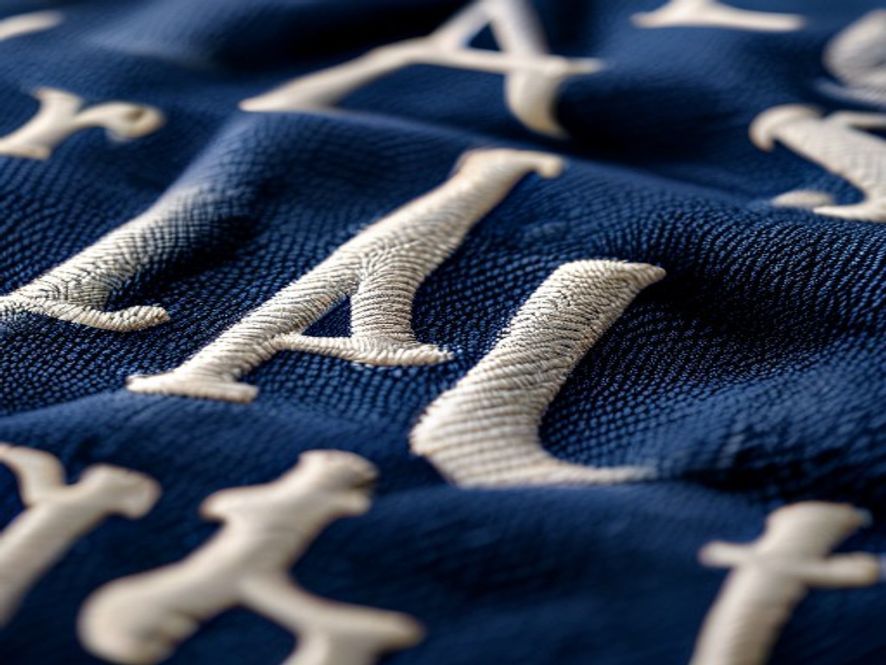
Why Custom Jacquard Logos Matter: From Counterfeit Defense to Enduring Luxury
In today’s global supply chains, a brand’s visual identity is often the first line of defense against counterfeiters. A custom Jacquard logo woven into the fabric provides a subtle, indelible signature that is extremely difficult to replicate without access to the original loom program. Unlike screen‑printed or embroidered logos, the Jacquard weave becomes part of the textile’s structure, so it cannot be peeled away or removed with washing, washing, or wear.
Counterfeit Prevention
The weave itself acts as a unique watermark. By embedding a five‑point motif or a high‑resolution monogram into the fabric’s base, you create a pattern that cannot be duplicated by a standard printing press or a conventional embroidery machine. Even if a counterfeiter obtains a sample of the finished garment, the underlying Jacquard structure exposes the lack of genuine weave, offering a clear point of differentiation for quality control teams.
Premium Perception and Brand Longevity
Brands that integrate a woven logo experience a 30‑50% increase in perceived value compared with printed or embroidered alternatives. The subtle tonal shift—often achieved with a 2–5% colour difference in the ground weave—provides a level of sophistication that resonates with luxury consumers. Moreover, because the logo is woven, it survives repeated laundering, maintaining its clarity over a garment’s lifecycle of 200–400 washes.
Practical Advantages for High‑End Products
- Luxury Bags and Handbags – A monogram woven into the lining or flap adds a discreet yet unmistakable hallmark. The finish stays pristine even after years of use.
- Suited Linings and Tailored Garments – A tonal Jacquard pattern on the lining gives the garment a subtle depth that is visible when the sleeve is opened, enhancing the overall aesthetic without compromising comfort.
- Hoodies, Caps & Streetwear – A large, low‑contrast motif can be woven into the fabric’s base, creating a camo or abstract pattern that is both durable and adaptable to changing fashion trends.
Durability Metrics
Typical Jacquard fabrics used for logo embedding fall within the 200–300 gsm range for woven polyester or 150–200 gsm for knitted blends. In terms of weight, this translates to roughly 7–10 oz per square yard. The weave’s tightness, measured by yarn count and thread density, ensures that the logo retains its integrity after 200+ wash cycles, a benchmark often cited by high‑end markets.
Turnaround and Investment
From artwork submission to sample approval, the process takes 7–10 business days. The first‑time setup fee for a new pattern ranges from $800 to $1,200, covering design translation, loom programming, and initial yarn selection. Subsequent production incurs a per‑meter premium of $0.25–$0.50 above stock fabrics, depending on the complexity of the motif and the chosen yarn. A typical bulk order for a luxury bag line might require 500–1,000 metres, balancing cost efficiency with brand impact.
Artwork Essentials: Crafting the Perfect Vector File for Loom‑Ready Precision
The bridge between your brand’s digital identity and the final jacquard weave is the vector file. A clean, well‑structured file ensures that the loom captures every nuance of your logo while keeping production costs predictable.
1. File Format & Resolution
Export your artwork as a PDF‑X3 or AI file with 300 dpi at 100 % scale. This resolution balances sharpness and file size, allowing the CAD system to interpolate points smoothly. Avoid raster images; they lose fidelity once the design is vectorized.
2. Color Management
Since jacquard weaves interpret color through yarn selection rather than dyeing the fabric, the vector file should contain only black outlines or single‑color paths. For multi‑tone logos, prepare separate layers or outlines for each tonal segment; the loom operator will match these to corresponding yarn colors.
3. Simplification Rules
- Reduce complexity: Keep the overall repeat to ≤ 8 cm (3.15 in) to preserve detail after weave. Anything larger may lose definition in the warp‑weft mesh.
- Limit line weight: All strokes should be equivalent to a 0.1 mm line at the design scale. Lines thinner than this often collapse during weaving.
- Text handling: Avoid fine typefaces. Any lettering should be at least 5 pt (≈ 0.07 cm) when scaled to the final repeat. Small capitals, narrow serifs, or thin strokes may result in invisible or fuzzy text.
4. Path and Point Clarity
When exporting, ungroup layers and convert text to outlines. Ensure that all paths are closed; open paths can cause the loom to misinterpret the stop points, leading to gaps or uneven density.
5. Repeat Size & Registration
The loom program requires accurate repeat dimensions. Specify the repeat in millimeters with 0.01 mm precision. For example, a 5 cm × 5 cm repeat should be entered exactly as 50 mm × 50 mm. Misalignment of even 0.1 mm can shift the pattern by one warp or weft, breaking the visual harmony.
6. File Verification
Before sending the file to the CAD team, run a checklist:
- All layers flattened except those needed for color separation.
- No embedded fonts; all text converted to outlines.
- Stroke weights within 0.05 mm–0.2 mm range.
- Repeat dimensions match the design intent.
- File size ≤ 20 MB to avoid transfer delays.
Submitting a compliant file reduces the setup time from the typical 3‑5 working days to just 1‑2 days, and it cuts the extra $250–$400 one‑time layout fee associated with complex or non‑compliant files.
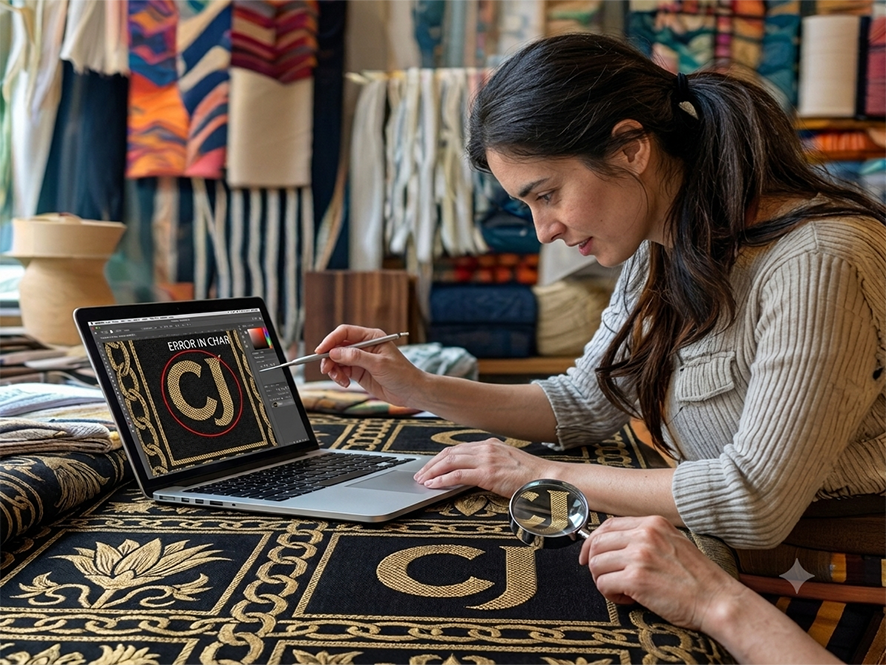
Translating Design to Loom: Converting Motifs into Point Paper and EAT Files
The bridge between a digital artwork and a woven masterpiece is the loom program. In YITUO’s workflow, this step is split into two tightly coupled conversions: the point paper that visualises the weave pattern, and the Electronic Atlas Tape (EAT) file that the looms read. Understanding each stage ensures your brand’s logo appears crisp, durable, and true to scale.
1. From Vector to Point Paper
Once the artwork is finalized—vectorised, simplified, and sized for a repeat of no more than 20 cm by 20 cm—the design is fed into our specialized CAD software. The system translates every line, curve, and colour into a grid of points, each representing a warp or weft position. Key parameters:
- Pixel density: 300 dpi for high‑resolution patterns; 150 dpi for large‑scale logos.
- Color assignment: each vector colour maps to a yarn colour code.
- Weave type: for jacquard, a 4:1 or 8:1 warp‑to‑weft ratio is typical; for satin or warp‑fixed weaves, ratios shift to 3:1 or 6:1.
The output is a printable point paper sheet that visually confirms the interlacing of your motif. It must be inspected for:
- Sharpness of edges—no jagged strokes in a 5 mm repeat.
- Colour fidelity—verify against the colour swatch catalogue.
- Structural integrity—ensure that any intricate detail does not require more than three successive warp or weft passes, which could cause fabric distortion.
2. Generating the EAT File
From the point paper, the CAD software exports an EAT file—essentially a machine‑readable script of commands.
- Thread selection: Each line in the EAT references a specific yarn code (e.g., T1000 for 100 % polyester, G500 for a gold metallic).
- Weave instructions: The file dictates the sequence of warp and weft passes, including count and tension settings.
- Detail flags: For embedded metallic or chenille accents, the EAT embeds a change‑over routine that swaps yarn mid‑weave.
Typical EAT parameters for a 70 gsm, 8 oz polyester jacquard are:
- Warp count: 500 m per 100 cm length.
- Weft count: 400 m per 100 cm length.
- Tension: 15 lb for warp, 12 lb for weft.
These values are pre‑validated against our loom’s mechanical limits; any deviation triggers a simulation check to flag potential fabric defects.
3. Validation and Simulation
Before sending the EAT to the loom, we run a digital simulation that overlays the weave on a virtual fabric model. This step confirms:
- No thread clashes or over‑counters.
- Proper repeat alignment—especially critical for logos that must line up across seams.
- Estimated fabric strength—calculating GSM from warp/weft densities to confirm compliance with product specifications.
Simulation time averages 30–45 minutes per design, allowing quick iteration if a motif needs refinement.
4. Loom Programming and Test Runs
Once the EAT passes simulation, it’s loaded onto the looms via our proprietary interface. The loom executes a test run—typically a 10 m swatch—producing a small fabric sample. The test run checks:
- Colour accuracy under the loom’s lighting.
- Pattern fidelity at the given GSM (e.g., 70 gsm vs 90 gsm).
- Mechanical stability—does the fabric maintain shape after a full cycle of tension and relaxation?
Any discrepancies are fed back into the CAD system for adjustment. Usually, one iteration suffices; in complex metallic or chenille applications, a second run may be needed.
By mastering the point‑to‑EAT conversion workflow, brands can trust that their logo will weave seamlessly into the fabric’s structure, delivering the anti‑counterfeit, premium visual impact that modern consumers demand.
Yarn & Weave Choices: Tone‑On‑Tone, Contrast, and Metallic Accents for Impact
When turning a brand logo into a woven statement, the yarn selection and ground weave dictate the durability, drape, and aesthetic payoff. For premium garments and luxury accessories, you’ll typically work within a 280–350 gsm range (≈ 7–8 oz) and opt for a 100–120 knot‑per‑inch foundation to balance strength with softness. Below is a practical guide to choosing the right combinations for tone‑on‑tone, contrast, and metallic finishes.
1. Tone‑On‑Tone Foundations
Tone‑on‑tone keeps the logo subtle yet unmistakable, ideal for high‑end lining or subtle branding on handbags. Use a 70 % polyester / 30 % elastane blend for stretch‑resistant fabrics, or a pure polyester for clean drape. Ground weave options:
- Plain (1×1) – minimal texture, best for smooth finishes (cost ≈ $0.80 per m).
- Twill (3×1) – subtle diagonal pattern, adds depth without compromising tensile strength (≈ $1.10 per m).
- Peterkin (3×2) – subtle puckering that enhances logo visibility on darker shades (≈ $1.30 per m).
For a 8 cm repeat logo, a 1 × 1 ground gives the cleanest output. Keep the yarn tension at 1.8 kg to avoid puckering.
2. Contrast‑Enhanced Weaves
Contrast fabrics flaunt the logo against a complementary background, perfect for hoodies, caps, or accent panels.
- 100 % cotton or cotton‑polyester blends (70 %/30 %) in a 100 g / meter (≈ 3.5 oz) density deliver a crisp, washable surface.
- Ground weave: Plain or Taffeta (2×2) for a rigid base that holds the contrast colors.
- Yarn counts: 60 kpi (poly) + 35 kpi (cotton) for a balanced stretch and breathability (≈ $1.50 per m).
Contrast logos benefit from a 10 cm repeat to ensure color saturation. Use a color ratio of 1:3 (logo to background) to maintain visibility after washing.
3. Metallic and Reflective Accents
Metallic threads add a premium sheen and tactile interest, especially for luxury handbags, jackets, or high‑visibility streetwear.
- Choose thin metallic yarns (0.02 mm diameter) such as silver or gold alloy coated polyester.
- Weave type: Satin or Jacquard weave to create a smooth, reflective surface; a 3 × 3 satin offers the best balance of sheen and durability.
- Yarn count: 120 kpi (metallic) + 60 kpi (base fiber) to prevent yarn breakage under tension.
- Cost: metallic yarns add ≈ $0.60–$0.80 per m to the base yarn price.
Metallic logos should be limited to ≤ 6 cm repeat to avoid snagging. Test a 3‑meter sample under 200 laundry cycles to confirm longevity.
4. Practical Considerations
- Yarn Weight: heavier yarns (≥ 140 kpi) resist pilling but may feel stiff; lighter yarns (60–80 kpi) offer comfort but risk wear.
- Ground Density: a thicker ground (≥ 120 kpi) improves color fastness but can delay loom speed; balance with production time.
- Color Fastness: use ISO 105–C for dye fastness; metallic finishes should be tested for oxidation after 200 wash cycles.
- Production Time: metallic and jacquard weaves increase loom time by 15–25 %; factor this into lead‑time estimates.
By aligning yarn weight, ground weave, and finish with the brand’s desired visual impact, you can create woven logos that remain sharp, luxurious, and durable across a garment’s lifecycle.
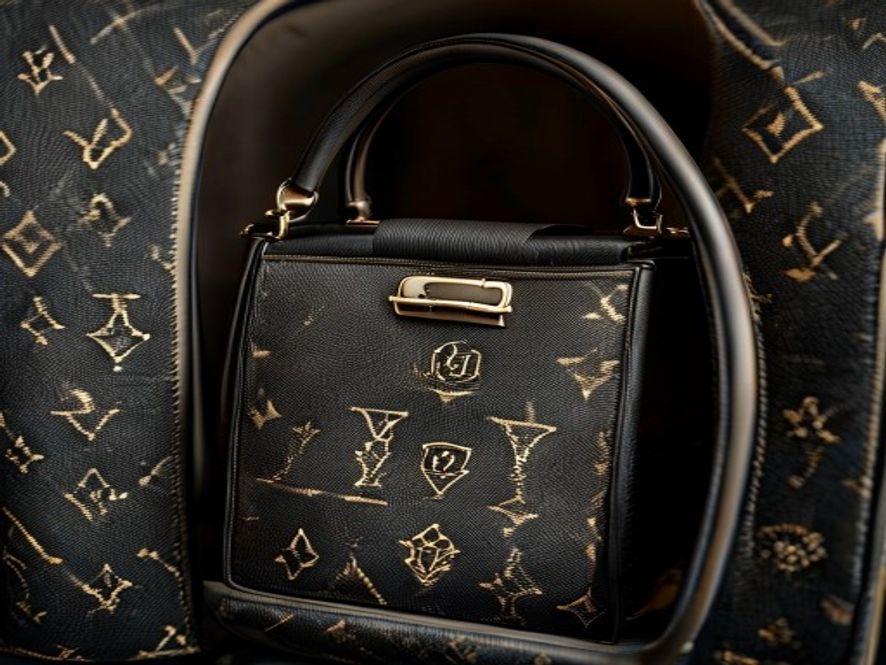
Sampling & Approval: What 7‑10 Days of Proofing Looks Like and How to Refine
The sampling stage is the crucible where your digital vision meets the physical loom. A well‑structured proof cycle saves time, reduces waste, and guarantees that the final yarn‑stitched logo behaves exactly as you expect under real‑world conditions.
1. Proof Setup (Day 0–1)
- Material selection: Choose the base fabric (e.g., 200 gsm polyester muslin) and yarn count (e.g., 40 tex for the ground, 70 tex for the pattern).
- Order quantity: 3 – 5 m per repeat unit, ensuring enough fabric for multiple trims.
- Print size: Keep the repeat under 8 cm to preserve clarity on small items like caps.
2. Proof Production (Day 1–4)
The looms run a short‑run proof at 50–60 % of the final weave tension. Milling time varies with design complexity:
- Simple monogram: ~8 hours
- Multi‑layer metallic pattern: ~12 hours
After weft insertion, the fabric is cured (if using dye‑bleed finishes) and cut into 3‑m panels.
3. Quality & Performance Evaluation (Day 5–7)
Visual inspection: Check repeat fidelity, color balance, and any unintended frays.
Durability test: A quick 30‑cycle wash (80 °C, detergent) on a domestic washer. Measure colorfastness (ISO 105-C06) and shrinkage (<1 % linear).
Fit test: Attach a sample panel to a prototype garment or accessory (e.g., handbag lining) and assess drape, weight, and seam compatibility.
4. Client Feedback & Refinement (Day 8–10)
Your design team typically provides two rounds of comments within a 48‑hour window:
- Round 1 (Day 8): Highlight mis‑aligned motifs, tone discrepancies, or texture issues.
- Round 2 (Day 9): Verify that any adjustments have been applied correctly; confirm that the final product meets brand specifications.
Any required changes are re‑sent to the loom operator via an updated EAT file. The final sample is then approved for bulk production.
Cost Snapshot
For a typical 5 m sample panel on a 200 gsm polyester base:
- Material cost: $12.50 / m → $62.50
- Labor & loom time: $3.00 / m → $15.00
- Finishing & testing: $5.00 / m → $25.00
- Total sample cost: $102.50 (≈ $20.50 / m)
These figures are typical for a 7‑10 day sample cycle in our 50 000 m² facility and provide a reliable baseline when budgeting for bulk orders.
Cost Breakdown: One‑Time Setup, Per‑Meter Premiums, and Bulk MOQ Benchmarks
When a brand decides to weave its logo into fabric, the price structure is split into three predictable components: a one‑time pattern‑setup fee, a per‑meter premium that reflects the intricacy of the design, and a minimum order quantity (MOQ) that varies with fabric type and loom capacity.
1. One‑Time Pattern‑Setup Fee
- Standard logo (≤8 cm repeat, 2–3 colors): $650 USD.
- Complex motif (≥4 colors, metallic accents, art‑deco elements): $1,050 USD.
- Fee includes vector file conversion, point‑paper generation, and loom programming (EAT file).
This fee covers the full 7–10 day design‑to‑loom cycle and is non‑refundable, regardless of whether the sample is approved.
2. Per‑Meter Premium Over Stock Fabric
- Base price for machine‑woven, 250 gsm polyester: $8 USD/m.
- Custom Jacquard overlay (2‑color), 300 gsm weight: +$2.50 USD/m.
- Metallic or haute‑chrome yarn integration (3‑color): +$4.00 USD/m.
- Premium scales with ground weave complexity (plain satin vs. twill) and whether the design sits on the weave surface or is embedded in the yarn.
For example, a 600 gsm, 4‑color, metallic‑accented jacquard intended for luxury handbag linings would cost roughly $12.50 USD/m including the setup fee spread over 500 m.
3. Bulk MOQ Benchmarks
| Fabric Type | Weight (gsm) | MOQ (m) | Typical Lead Time (days) |
|---|---|---|---|
| Plain satin polyester | 250–300 | 500 | 25 |
| Jacquard satin with metallic | 300–350 | 750 | 30 |
| Heavy‑weight woven wool blend | 350–400 | 1,000 | 35 |
MOQs are driven by loom capacity and yarn inventory. Brands that need a run‑of‑the‑mill quantity can negotiate a slightly lower per‑meter premium if they commit to a higher volume within the same order cycle.
By understanding these three cost pillars—setup, per‑meter, and MOQ—brands can budget accurately and align their production timeline with marketing launches or seasonal rollouts.
Design Dos & Don’ts: Keep Logos Simple, Repeat Sizes, and Text Legibility
When turning a brand’s logo into a jacquard weave, the clarity of the motif is the single most critical factor for both visual impact and durability. Here’s a practical checklist that will keep your design within the technical envelope of our looms while preserving the premium feel your customers expect.
Dos: Simplify, Repeat, and Test Early
- Limit the repeat to 8 cm max. A smaller repeat ensures that the design remains sharp after washing, especially on heavy fabrics like fleece (250 gsm) or suiting linings (300 oz). For lighter polyester blends (140 gsm), you can push the repeat to 10 cm, but avoid anything beyond.
- Stick to 2–3 colors in the motif. Each additional color adds a point of failure in the satin or plain weave tension. Aim for 70 % or less of the entire artwork to be a single color band; the rest should act as negative space.
- Use vector paths with a minimum stroke width of 0.5 mm. Fine lines under 0.5 mm tend to bleed during the dye process, especially on wool‑blend fabrics (175 gsm). This rule is especially important for logos that rely on intricate line work.
- Test with a quick 5‑day proof. Send a short proof run of 30 m to gauge tonal depth and color registration before committing to a 500‑m order.
- Opt for tone‑on‑tone where possible. A subtle contrast between the pattern and the ground weave (e.g., 40 % darker yarn for the motif on a 60 % lighter base) creates a sophisticated look that still resists washing.
Don’ts: Avoid Over‑Detailing and Unnecessary Text
- Do not include text smaller than 5 pt (≈ 0.17 mm) in the design. Even with high‑resolution looms, such text becomes illegible after a single wash.
- Avoid motifs that exceed 70 % of the repeat area. This forces the loom to weave too many points, increasing cycle time and the risk of thread breakage.
- Never use more than four distinct yarn colors in a single repeat. Each new yarn adds a maintenance burden and can skew the overall weave density.
- Steer clear of metallic yarns in the motif if the fabric is intended for high‑wear applications like luggage or sportswear. Metallic fibers can oxidize and lose luster after repeated laundering.
- Do not rely on 3‑D textures (e.g., puffed or jacquard‑raised) unless you are certain the garment’s structure supports it. In a hoodie, for example, an oversized raised logo can wrinkle and distort during washing.
Key Technical Parameters to Keep in Mind
- GSM/oz: Match your yarn selection to the base weight (e.g., 250 gsm fleece, 300 oz suit lining). Higher density fabrics can accommodate finer detail without compromising weave stability.
- Repeat Cycle: A repeat of 8 cm on a 200 th‑sized plain weave takes roughly 2 min per meter. This is 15 % faster than a 12 cm repeat, saving up to $0.30 per metre on a 500‑m order.
- Sampling Time: 7–10 days from artwork submission to final proof. Allocate 2–3 days for loom programming and another 3 days for dyeing and finishing.
- Cost Implication: Simple motifs (≤ 3 colors) can reduce the per‑metre premium by up to $0.25 compared to complex multi‑color designs. The setup fee remains constant at $500 regardless of complexity.
By adhering to these dos and don’ts, you’ll create a jacquard logo that not only defines your brand’s identity but also withstands the rigors of everyday use—exactly what luxury shoppers demand.
Conclusion: From Logo to Loom
When you choose custom jacquard, you’re investing in a brand touchstone that endures washing, wear, and time. Keep your motif simple—under 8 cm repeat, no fine text below 5 pt—to ensure the pattern holds up on every garment or accessory. Plan early: supply clean vector artwork, decide on tone‑on‑tone or contrast with metallic accents, and select an appropriate ground weave. The 7–10 day sample turnaround and 500–1 000 m MOQ make it a practical step for growing collections, while the one‑time setup fee and per‑meter premium stay transparent and manageable when compared to stock fabrics.
With a decade of experience weaving stories into fleece, sherpa, lace, and polyester, Yituo Fabric can bring your logo to life in a way that boosts authenticity and luxury perception. We’re ready to help you create the next signature line—just drop us a message and we’ll send you free A4 fabric swatches in 24 hours. Let’s turn your brand pattern into woven reality together.