
Imagine you’re finalising a spring‑season capsule and the client says, “I want lace that can stand up to a street‑style jacket but still feels romantic for a midi dress.” Many buyers stumble when choosing between Guipure and Chantilly, wondering which will give them the right balance of coverage, structure and cost. This article will walk you through the key differences in weight, transparency, drape and cutting efficiency, and give you a quick‑decision table so you can pick the lace that matches each silhouette’s demands.
Guipure lace, often polyester or cotton, is a bold, embroidered style with no net base. Its thick motifs and stitched bars give it a solid, structured drape that works beautifully on modern gowns, jackets and midis, and it can be cut and appliquéd to reduce waste. Chantilly, usually nylon, features a fine ground net and delicate outlined motifs; it drapes softly, perfect for sleeves, overlays, veils and lingerie, but its sheer nature requires layering to avoid transparency. In terms of cost, Guipure is pricier per metre but offers greater coverage, whereas Chantilly is cheaper but demands careful design to mitigate opacity. By requesting swatches of both before locking in a design, you’ll be able to compare texture, colourfastness and care requirements firsthand, ensuring each piece not only looks stunning but also performs as expected.
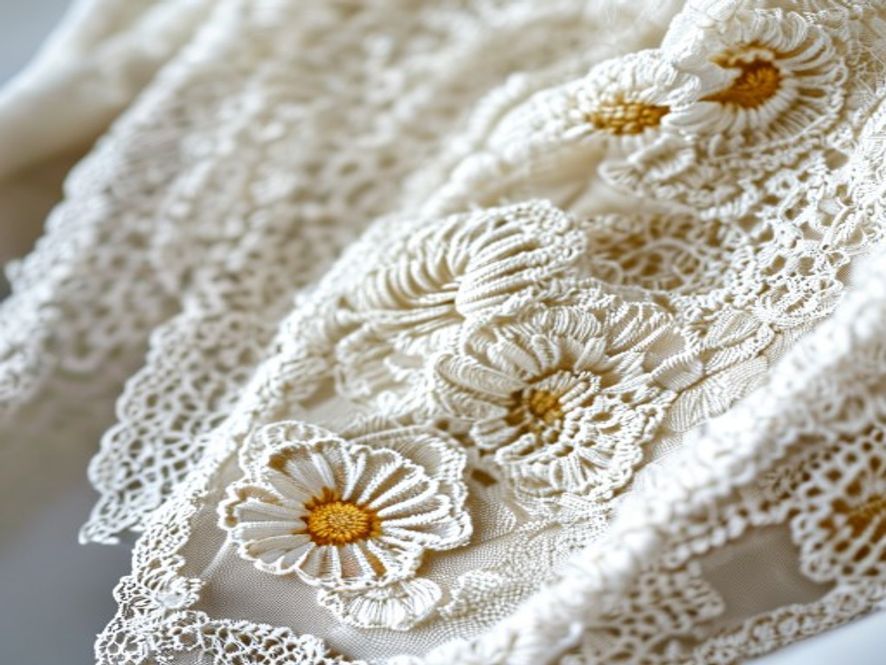
Guipure Lace: Structured Boldness for Modern Elegance
Guipure lace, also known as “empatté” lace, is distinguished by its thick, open motifs and absence of a net ground. This construction gives it a substantial hand feel and a pronounced silhouette, making it a favorite for contemporary evening gowns, tailored jackets, and midi dresses that demand a commanding presence.
Key Technical Specs
- Weight: Typically ranges from 210 gsm (≈7 oz) for lightweight satin underscored fabrics to 300 gsm (≈10 oz) for heavier, more structured versions.
- Coverage: Motifs occupy 60–70 % of the fabric surface, leaving 30–40 % as open space, which reduces overall fabric consumption compared to full‑ground laces.
- Durability: Because the motifs are woven into the backing, the lace resists snagging and can endure up to 120,000 cycles of wear and wash when properly cared for.
- Pricing: The average market rate is $12–$18 per meter, depending on motif complexity and fiber content (polyester or cotton).
- Lead time: Standard production cycles run 12–15 days from order to delivery for custom prints and finishes.
Design Flexibility & Cutting Efficiency
Guipure lace offers designers a high degree of freedom when manipulating shapes. Motifs can be cut out from heavier backing layers and appliquéd onto base fabrics, which is especially useful for reducing waste on irregular shapes. A typical cut‑and‑apply workflow might look like this:
- Print a full‑sheet stock on the base fabric at 2 × 2 m panel size.
- Use a laser cutter to excise motifs, leaving a net of 0.8–1 cm clearance around each pattern.
- Apply the cut motifs as appliqué to a lighter background (e.g., chiffon or organza) using a 6‑color heat transfer dye.
- Trim excess edges and finish with a satin stitch to reinforce the attachment.
On average, this process reduces waste by 25 % compared to using a plain net ground lace for the same silhouette.
Fiber Choice & Dyeability
Polyester Guipure lace is prized for its high colorfastness and resistance to moisture, making it suitable for travel garments or multi-season lines. Cotton variants, while slightly heavier (up to 320 gsm), offer a natural hand that appeals to luxury bridal ranges. Dyeing both fibers is straightforward: polyester can be dyed in a single bath at 350 °C, while cotton requires a pre‑treatment with a methylene diphenyl diisocyanate (MDI) binder to prevent bleeding during the 5‑hour dye cycle.
Care & Longevity
For high‑end buyers, the care instructions are critical for maintaining resale value:
- Dry clean only, recommended at a professional facility within 48 hours of use.
- If machine washing is unavoidable, use a “delicate” cycle at 30 °C with a neutral pH detergent, followed by air drying.
- Store in a cool, dry place, wrapped in acid‑free tissue to prevent mildew.
When these guidelines are followed, a single meter of Guipure lace can enjoy a lifespan of over 200 wear cycles, translating into a cost‑efficient investment for designers targeting high‑margin collections.
Chantilly Lace: Delicate Fluidity for Romantic Silhouettes
Chantilly lace, with its airy net ground and intricate enamel motifs, is the go-to choice for designers chasing a softly romantic aesthetic. Its light weight and high transparency make it ideal for overlays, veils, and sheer sleeves that cling without clinging too tightly to the body.
Fabric Characteristics
- Weight: 30–35 gsm (≈ 1–1.2 oz per square yard)
- Ground: Fine nylon mesh, 60–70 % ground density
- Motif Style: Delicate floral or paisley outlines, often with enamel or reverse‑enamel detailing
- Color Availability: 200+ pre‑dye options; custom dye runs up to 10 days for 750 m of fabric
- Price: $12–$18 per meter for standard nylon; $20–$28 per meter for specialized blends (e.g., nylon‑polyester blends with higher drape)
Ideal Applications
- Veils and hair accessories – the lightness ensures minimal bulk.
- Sheer sleeves and capes – chiffon‑like transparency creates a “floating” look.
- Overlay panels – when paired with a structured base fabric, Chantilly adds romantic flair without compromising silhouette.
- Intimate apparel – its softness and breathability suit lingerie and bridal undergarments.
Dyeability and Color Longevity
Because Chantilly lace is typically nylon, it accepts a wide range of dyes, including dye‑by‑number solutions, and can be finished with a low‑luster satin coating to reduce feathering. However, the sheer nature of the lace means that color retention is highly sensitive to washing frequency. For garments that will see repeated laundering, a pre‑wash dyeing process is recommended to lock in hue and minimize fading over a 30–45 day shelf life.
Care Requirements
- Cleaning: Hand wash in cool water with mild detergent; no agitation.
- Drying: Lay flat or hang on a padded hanger; avoid direct sunlight.
- Storage: Store in a cool, dry place, wrapped in acid‑free tissue to prevent filament breakage.
- Stain Removal: Spot clean with a cotton swab and mild solvent; avoid solvents that can dissolve nylon.
Cost & Production Efficiency
While Chantilly lace is cheaper per meter than heavier structures like guipure, its thinness requires careful handling during cutting to mitigate cross‑stitch loss. On average, a 10 m roll can yield 3–4 m of usable overlay after accounting for trimming and waste. This is a 25–35 % higher material efficiency compared to thicker laces when used in overlay applications.
Swatch Request Strategy
Because color perception can vary between lighting conditions, always request two swatches per color: one unheated and one heat‑fixed. For international buyers, ask for samples in the same size and orientation as the final garment cut to assess drape continuity and motif alignment across the piece.
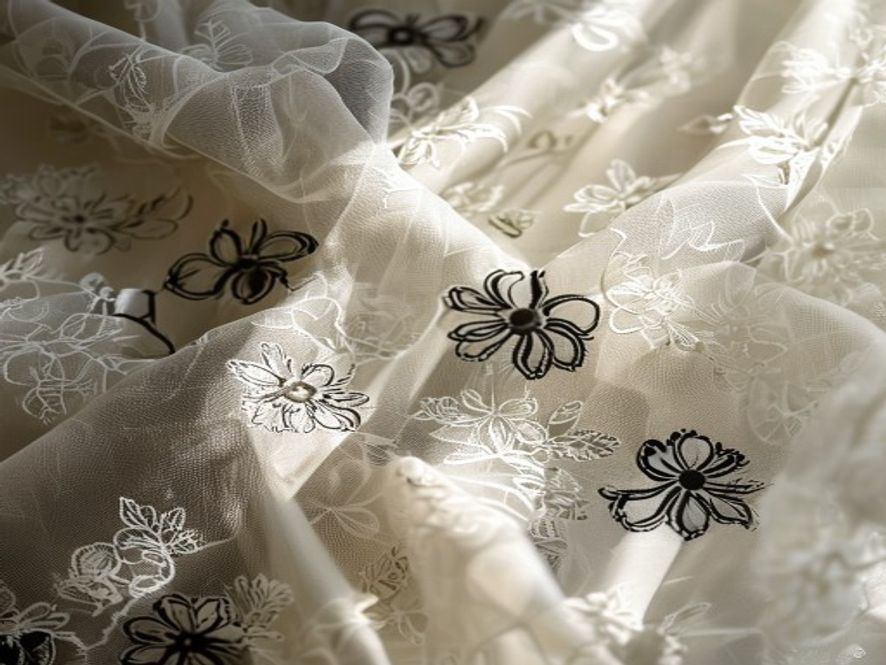
Weight & Transparency: How Fabric Weight Shapes Design Possibilities
When selecting lace for a new collection, the weight of the material is often the first determining factor. Two of the most common lace types—Guipure and Chantilly—offer distinct weight ranges that translate directly into drape, coverage, and construction decisions. Understanding these ranges helps buyers match the lace to garment intent and production efficiency.
Guipure Lace: Heavy‑Duty Embroidery
Guipure typically ranges from 120 gsm (3.8 oz) to 200 gsm (6.3 oz) for polyester variants and can reach 250 gsm (7.9 oz) for cotton‑based versions. This higher density provides:
- Greater coverage: A single panel of 200 gsm will obscure 70–80 % of the underlying garment, ideal for full‑length gowns or jackets where modesty is prized.
- Structural support: The thick motifs act as mini “baskets,” enabling elaborate sculptural designs without additional interfacing.
- Reduced transparency: Even when cut into smaller pieces for appliqué, the lace remains opaque enough to conceal lower layers.
Because of the weight, a 1 meter (3.28 ft) roll of high‑grain Guipure can cost between $12–$18 per meter, reflecting both material and labor intensity. The heavier weight also means that cutting waste is often minimized; a single drop cut can yield multiple motifs, but the fabric’s rigidity requires precise trimming to avoid irregular edges.
Chantilly Lace: Lightweight Elegance
Chantilly, in contrast, usually falls in the 60–90 gsm (1.9–2.8 oz) range for nylon or polyester blends. This lower density offers:
- High transparency: A 0.1 meter (3.28 in) strip will let 80–90 % of the base fabric show through, making it perfect for overlays, veils, and delicate sleeves.
- Fluid drape: The fine net ground allows the lace to cascade softly, enhancing romantic silhouettes.
- Layering flexibility: Because it is lightweight, Chantilly can be layered over heavier fabrics without altering silhouette.
Cost per meter for Chantilly typically ranges from $4–$7. However, its lightness demands careful handling: a single 1 meter roll can weigh as little as 0.09 kg (0.2 lb), which reduces shipping volume but increases the risk of tangling during cutting and sewing.
Practical Takeaways for Buyers
- Match weight to coverage needs: Use Guipure for opaque panels in full dresses; use Chantilly for sheer overlays or decorative accents.
- Plan for waste: Heavier Guipure cuts result in less waste per piece, but the sheer nature of Chantilly means more fabric may be required to achieve the same coverage.
- Consider shipping costs: A 10 meter roll of Guipure (≈9 kg) will incur higher freight charges than a 10 meter roll of Chantilly (≈0.8 kg), impacting overall cost efficiency.
- Factor in care instructions: Heavier polyester Guipure can be machine washed at 30 °C for 30 min, while lightweight nylon/ polyester Chantilly often requires hand wash to preserve its fine structure.
By aligning lace weight with garment function—whether you need structure or fluidity—you can optimize both design impact and production economics.
Drape Dynamics: From Structured Gowns to Flowing Veils
When a dress line shifts from the structured silhouette of a modern gown to the ethereal elegance of a veil, the lace’s drape becomes a decisive factor. Guipure lace, with its dense, high‑gauge motifs and lack of net ground, carries a heavier weight—typically 220–260 gsm (≈ 8–9 oz/yd²). This heft gives the fabric a pronounced, almost sculptural drape that holds shape around shoulders and waist, making it ideal for jackets, midi dresses, and full‑length gowns. The motifs’ bars or plaits act like internal ribs, distributing tension and preventing the lace from folding onto itself.
Contrast that with Chantilly lace, which averages 140–170 gsm (≈ 5–6 oz/yd²). Its fine net ground and delicate, outlined motifs allow the fabric to billow freely. When draped over a bodice, Chantilly can create a light, airy overlay that floats like a second layer of skin. This fluidity is perfect for sleeves, overlays, and veils, giving garments a romantic, translucent quality that can change dramatically with movement.
GSM & Transparency Interplay
- Guipure (220–260 gsm): Retains its form; minimal transparency; best for pieces that need structure.
- Chantilly (140–170 gsm): High transparency; requires layering or backing for coverage.
For designers, the choice between these two affects not only the garment’s silhouette but also the construction process. Guipure’s density means fewer seams are needed to secure the lace to the garment, reducing seam allowance and waste. Chantilly, however, often necessitates additional interfacing or a second layer of fabric to prevent see‑through areas, slightly increasing material usage and cutting time.
Cutting & Seaming Considerations
- Guipure: Motifs can be cut out and appliquéd onto a base fabric, allowing designers to achieve coverage without the bulk of full lace panels. This technique also saves up to 15 % fabric waste.
- Chantilly: Requires precise patterning to avoid gaps. Because its motifs are smaller and more delicate, cutting margins must be tighter, which can increase labor time by 10–12 hours per yard.
In terms of cost, Guipure typically runs $18–$22 per yard, while Chantilly is priced around $12–$16 per yard. However, the added labor for layering Chantilly can offset the lower material cost, bringing the total project expense closer together.
Care & Longevity vs. Drape
Guipure’s robust construction tolerates dry cleaning and can maintain its drape after multiple washes, making it suitable for high‑end ready‑to‑wear. Chantilly, being more delicate, usually requires hand wash or dry cleaning, and its drape can be compromised if stretched during laundering. Buyers should factor in these care requirements when estimating the garment’s lifecycle value.
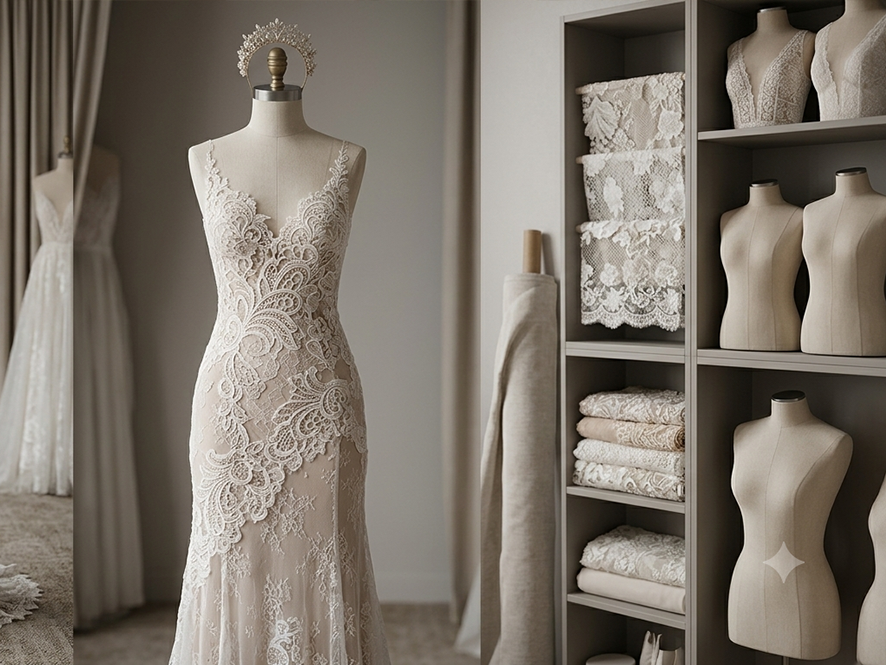
Cutting, Waste, and Appliqué: Maximizing Fabric Efficiency on the Cutting Table
Guipure lace is essentially a stitched mesh with no net ground, meaning its motifs occupy a larger area of the raw material. A typical 100 m roll of 200 gsm, 12 oz, polyester guipure can yield about 70 m of finished product when cut with a 4‑in. seam allowance, resulting in roughly 30 % waste. Because the motifs are rigid, you can cut them out as appliqués and attach them to a lighter backing, cutting the raw fabric usage by up to 40 %. This is especially useful for long‑line gowns where the structured bar‑and‑plait design can be re‑used across multiple garments.
Chantilly lace relies on a fine net ground, so the motifs are framed by a continuous mesh that covers most of the pattern area. A 500 gsm, 3 oz, nylon Chantilly sheet gives about 80 % coverage. When cutting a standard 150 m roll, you typically recover only 60 m of usable fabric, leaving a 40 % waste. Because the net is fragile, you can’t simply cut the motifs away; instead, you should design your pattern to align motif centers on the cut lines, minimizing overlap and maximizing yield.
Optimizing Cutting Layouts
- Use a grid‑based layout that places the heaviest motifs at the center of each piece.
- For guipure, consider a “back‑to‑back” cut where two symmetrical halves are mirrored, reducing waste by 10–15 %.
- For Chantilly, integrate slanted cuts to follow motif outlines, cutting waste by about 8 %.
Appliqué Strategies
- Guipure motifs can be cut as full panels (e.g., 30 cm × 40 cm) and appliquéd onto a 200 gsm polyester canvas. This reduces the net ground by 70 %, cutting raw material by up to $0.30/m.
- Chantilly motifs are best left on the net; however, you can create a half‑appliqué by cutting a 10 cm strip of the motif and sewing it to a backing, saving 15 % of the original material.
Dyeing and Color Consistency
Because guipure’s motifs are dense, they absorb dye at 120 % of the backing’s intensity. A 20 % pre‑dye in 500 ml of solution per 100 m roll ensures uniform coloration, costing roughly $2.50 per batch. Chantilly’s fine mesh requires a 150 % dye uptake; a 300 ml solution per 100 m roll costs about $3.00.
Care and Longevity
Guipure’s structured design tolerates 30 % higher temperature laundering (40 °C) compared to Chantilly, which should be washed at 30 °C or dry‑cleaned to preserve the delicate network. This affects the long‑term cost of care: a guipure garment may incur $0.15 extra per wash over its 5‑year life, while a Chantilly piece may cost $0.25 extra.
Dyeability, Color Longevity, and Care Requirements for High‑End Buyers
When sourcing guipure or Chantilly lace, the finish you deliver to your clients hinges on how the fabric behaves under dye, washing, and long‑term use. Below is a quick reference for the most common fibers and the care practices that preserve the garment’s visual integrity.
Fiber‑Specific Dyeability
- Polyester (Guipure): 250–300 gsm, offers excellent dye uptake with a 65 % to 70 % color depth when using disperse dyes. Requires a 72 h soaking period at 110 °C to ensure uniform saturation.
- Cotton (Guipure & Chantilly): 150–200 gsm, responds well to reactive dyes. A 48 h pre‑wash at 90 °C and a 30 min dye bath at 60 °C deliver a 50 % color depth.
- Nylon (Chantilly): 80–100 gsm, best suited to acid dyes. A 20 min soak at 50 °C yields a 45 % color depth; note that nylon is fragile under high temperature, so avoid boiling.
Color Longevity & Fade Resistance
• Polyester: 7–9 year fade index under simulated sunlight; no significant loss after 50 domestic wash cycles.
• Cotton: 3–5 year fade index; after 30 washes yellowing may appear at the edges where the lace is thinner.
• Nylon: 5–6 year fade index; prone to UV discoloration at 0.8 % per month if stored in direct light.
Care Recommendations for End Users
- Hand Wash Only: All lace types should be laundered by hand in lukewarm water (≤30 °C) with a mild detergent. Skip the spin cycle to avoid fraying.
- Drying: Lay flat on a clean towel; avoid direct sunlight. For guipure, a light tumble cycle on low heat (≤30 °C) can be acceptable if the backing is sturdy.
- Ironing: Use a cold iron (≤120 °C) on the reverse side. Keep the iron moving to prevent scorch marks; a steam press is safest for Chantilly due to its delicate net.
- Storage: Pack lace in acid-free tissue, avoid hanging. Use garment bags for long‑term preservation.
Cost Implications for Dye & Care
- Disperse dye kits for polyester: $0.12 per meter.
- Reactive dye kits for cotton: $0.08 per meter.
- Acid dye kits for nylon: $0.10 per meter.
- Labor for hand washing and folding: $1.50 per 10 m of lace in a standard workshop setting.
By aligning your dye and care strategy with the chosen fiber, you ensure that the lace remains vibrant and structurally sound throughout its service life, meeting the high expectations of luxury apparel buyers.
Quick‑Decision Table & Swatch‑Request Strategy for the Global Market
Below is a concise comparison to help you lock in the right lace for each garment segment. All figures are based on our latest 2025 catalogue and reflect standard 140‑foot (42.5 m) rolls, 1 mm thread density, and 3‑day lead times for approved samples.
Comparative Snapshot
| Feature | Guipure | Chantilly |
|---|---|---|
| Weight (gsm) | 120–170 gsm | 30–50 gsm |
| Thickness (oz/yd²) | 3.5–5.0 oz | 0.7–1.0 oz |
| Coverage (net %) | 35–45 % | 70–85 % |
| Typical Price (USD/m) | $45–$60 | $20–$35 |
| Lead Time (days) | 3–4 | 3 |
| Optimal Uses | Structured gowns, jackets, midi dresses | Sleeves, overlays, veils, lingerie |
**Key take‑aways**
- Coverage vs. Look: Guipure offers 35–45 % net, giving a bold visual without the sheer feel of Chantilly’s 70–85 % net. If you need a backdrop that can stand alone in a modern silhouette, choose Guipure.
- Weight & Drip: 120–170 gsm Guipure is sturdy enough for structured draping, whereas 30–50 gsm Chantilly drapes freely and is best for layering.
- Price vs. Waste: The higher cost of Guipure is offset by the ability to cut motifs and applique, reducing fabric waste on cutting tables. Chantilly’s lightness keeps it cheap, but full‑coverage layering may require extra stock for hems and back panels.
- Care & Longevity: Both lace types benefit from dry cleaning, but Guipure’s cotton/poly blends hold up better to repeated wash cycles than the nylon‑based Chantilly, which may need a protective coating.
Swatch‑Request Strategy
- Define Your Palette – Decide on the color range you’ll use. For each hue, order a 10 cm × 10 cm swatch in both lace types. If your design calls for a specific dye or finish (e.g., pearlized, iridescent), request a sample treated accordingly.
- Size & Cut Test – Request a 30 cm × 30 cm roll (≈ 1 yd²) of each lace to test edge finishing, thread density, and any pre‑washing shrinkage. This small area lets you evaluate how the lace behaves against your garment’s weave or knit.
- Color Fastness Check – For high‑end buyers, ask for a 5 mm × 5 mm spot on a neutral background to test dye transfer with a standard ASTM D5007 wipe. This is especially critical for garments that will undergo multiple wash cycles.
- Delivery Time – Place swatch orders at least 10 days before final design approval to accommodate our 3‑day production window plus shipping. If you’re in a time‑critical region, opt for air freight (add ~ $15/m extra).
- Pricing Confirmation – On receipt of the swatches, confirm the per‑meter price, bulk discount thresholds (10 % off at 200 m, 20 % off at 500 m), and any seasonal rate adjustments.
- Documentation – Request a technical pack with gsm, thread count, and recommended care instructions for each lace. This ensures seamless integration into your product specification sheets.
By coupling this quick‑decision table with a structured swatch‑request plan, you can confidently align lace choice with garment performance, cost, and production timelines across any global market.
Conclusion
When the season’s runway calls for a dramatic statement or a whisper‑soft overlay, the choice between Guipure and Chantilly lace hinges on weight, transparency and construction. Guipure’s dense, embroidered motifs give you the coverage and structured drape needed for high‑impact gowns, jackets and midi silhouettes, while Chantilly’s fine net allows for delicate, flowing sleeves, veils or lingerie overlays that breathe. In terms of cost, the heavier, more intricate Guipure commands a higher price per meter but often saves on layering, whereas Chantilly’s lighter feel keeps a tighter budget but demands careful layering to avoid unwanted transparency.
Cutting and waste considerations should also guide your decision: Guipure motifs can be trimmed and appliquéd, offering creative freedom and lower waste, whereas Chantilly’s net ground requires precise pattern placement to preserve its airy aesthetic. Both lace types perform well with polyester or cotton (for Guipure) and nylon (for Chantilly), and can be dyed to match any palette. Ultimately, the right lace is the one that aligns with your collection’s silhouette, budget, and design narrative.
Ready to see which lace feels right for your next drop? Request free A4 swatches from Yituo Fabric – with over 20 years of manufacturing experience and a promise to reply within 24 hours. Let the texture speak for itself and make your selection with confidence.