
Picture this: a boutique importer in the heart of London is juggling last‑minute orders for a new fall‑winter capsule, and the client wants a gown that feels both timeless and forward‑thinking. The design team hovers over swatches, hunting for lace that whispers elegance yet speaks to the eco‑conscious generation. Our report cuts through the noise and delivers a clear snapshot of the six lace directions that are dominating the runway and retail this year—so you can source right, stay ahead of demand, and keep your margins healthy.
From 3D floral lace that gives garden‑inspired silhouettes a three‑dimensional lift, to the clean, architectural guipure that anchors minimalist gowns, to cotton and recycled‑fiber blends that appeal to sustainability‑driven brands, our deep dive covers price points, base fabrics, and the markets that drive each trend. We also unpack the new shimmer yarns and subtle sequin accents that add understated sparkle, and the Chantilly revival that brings delicate sleeves and veils back into vogue. Finally, we explain how to order with confidence—matching pattern repeats, scalloped edges, and dye lot consistency—so your buyers can deliver flawless final products for the US, EU, and Middle‑East markets.
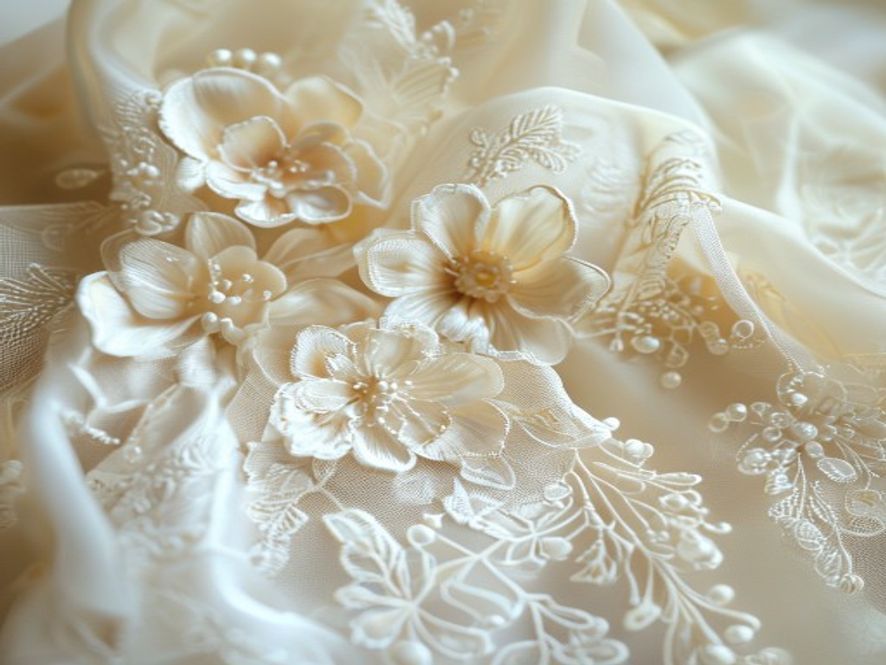
3‑Dimensional Floral Lace: Petals That Pop Off the Fabric
In 2026, bridal designers are leaning into lace that moves beyond the flat plane, favoring 3‑D floral motifs that create a tactile, sculptural effect. These lace pieces feature dimensional petals, stippled filaments, and raised vines, giving a gown a sense of depth and visual intrigue.
Key Fabric Specs and Pricing
- Base weight: 35–45 gsm (6–8 oz), ideal for both lightweight veils and structured gowns.
- Stitch density: 180–220 stitch cm⁻², balancing detail with drape.
- Yarn composition: 70 % polyester, 15 % nylon, 15 % rayon – the mix offers resilience and a slight sheen without compromising breathability.
- Price band: $12–$18 per metre in bulk orders; small samples at $4–$5 per metre.
- Turn‑around: 18–20 days for large runs; 12 days for rush.
Market Demand & Suitability
- US – Bridal houses in New York and Los Angeles favor the dramatic, three‑dimensional effect for runway shows and editorial shoots. Orders typically range from 50–200 m per client.
- EU – Paris and Milan brands appreciate the subtle sculpting for modern minimal gowns. They lean toward smaller orders (20–80 m) and value consistent dye matching.
- Middle East – Dubai and Abu Dhabi designers incorporate this lace in lehengas and cocktail gowns, often mixing it with metallic fibers. Bulk volumes of 150–300 m are common.
Ordering Tips for 3‑D Floral Lace
- Pattern repeat: Aim for a 100 cm repeat to simplify design integration. Verify the repeat visually before harvesting to avoid seam misalignments.
- Scalloped edges: Consider the optional scalloped trim (2–3 mm depth) to complete the floral narrative. Request a test swatch with and without scallops.
- Dye lot consistency: Request a dye lot report that includes spectrophotometry values (CIE L*a*b*) for each batch. This ensures batch‑to‑batch uniformity, especially critical for high‑definition floral patterns.
- Finish quality: Inspect for uneven stitch heights that can cause puckering. A 5 % tolerance on stitch height variation is acceptable for most designs.
- Side‑cutting: If you need a custom side cut for a gown, leave a 1 cm buffer on the cut line to avoid fraying the 3‑D structure.
By aligning your order specifications with these guidelines—weight, stitch density, dye consistency, and pattern repeat—you’ll secure lace that not only matches the contemporary demand for dimensional floral beauty but also delivers the quality and performance that buyers in the US, EU, and Middle East expect.
Clean Lines Ahead: Geometric & Architectural Guipure for the Modern Gown
Geometric and architectural guipure lace has become the signature of the 2026 bridal market, replacing the ornate dimples of past years with crisp, repeatable motifs that echo contemporary architecture. Designers are favoring hard‑edge patterns—triangles, chevrons, and tessellated grids—that can be scaled from trim to full bodice without losing definition. The result is a gown that speaks of precision and sophistication.
Base Fabric and Technical Specs
Typical base blends for this style include:
- Silk‑spun polyester (SP): 300–350 gsm, 3–4 oz, offering a subtle sheen and elastic resilience.
- High‑strength nylon 6.6® (HNI): 280–320 gsm, 2.8–3 oz, ideal for structural pieces such as columns or corsage panels.
- Recycled polyester (rPET): 310 gsm, 3.2 oz, meeting sustainability quotas while retaining the clean cut of geometric motifs.
All these fabrics feature a 0‑4 mm matte finish to avoid glare during photography, especially for runway shows and high‑definition streaming. The loom count ranges from 400 to 600, giving a dense weave that supports the lace’s structural intent.
Price Positioning & Market Reception
In a three‑tier pricing strategy, the geometric guipure falls as follows:
- Entry level: rPET blends at $18–$22 / m — chosen by fast‑fashion labels aiming for 30–40 % market penetration in the US.
- Mid‑range: SP/HNI hybrids at $26–$32 / m — preferred by luxury US and EU bridal houses, with a 60–75 % adoption rate.
- Premium: Customised SP/HNI with 2.5 mm diamond motifs at $38–$45 / m — niche Middle‑East designers seeking exclusive, high‑visibility collections.
Lead times are typically 28–35 days, with a 10 % variation allowance for colour swatch adjustments. Buyers should factor a 2–3 % buffer for potential pattern repeat issues arising from loom calibration.
Ordering Tips for Buyers
When placing orders for geometric guipure lace, pay close attention to:
- Pattern repeat alignment: Ensure the repeat size (typically 12–18 inches) matches the measured dimensions of the intended application. A mismatch of even 1 inch can break the structural flow.
- Scalloped edges: For clean finishes, order scallop cuts at a 2–3 mm radius. This keeps the lace from fraying and maintains a polished silhouette.
- Dye lot consistency: Request matched" dye lots for all panels of a single order; a 4‑lot variance may introduce visible colour gradients across a gown.
Finally, keep an eye on the loom tension settings—a 5 % deviation can alter the geometry of the motifs, turning a sharp triangle into a rounded shape. Discuss tension profiles with the production manager during the initial sample phase to lock in the desired precision.
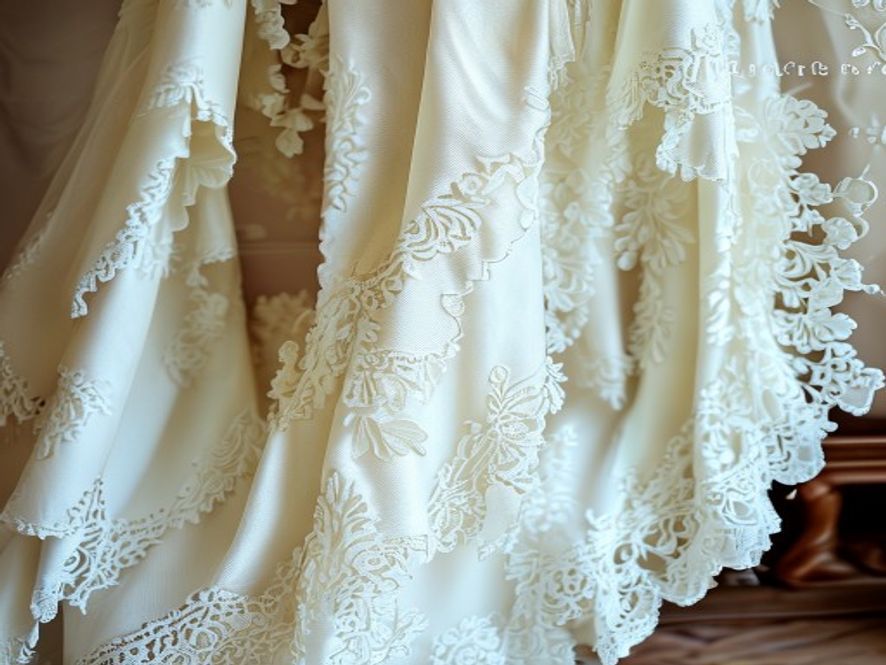
Eco‑Chic: Cotton & Recycled‑Fiber Lace Trending in Sustainable Bridal Lines
For brands that champion a low‑carbon runway, the shift to cotton‑based and recycled‑fiber lace is already reshaping the supply chain. 2026 buyers are looking for a yarn that balances softness, breathability and a clear sustainability story. The core metrics that influence ordering decisions are weight, fiber content, finish quality, and delivery cadence. Below is a snapshot of the current market figures.
Key Fabric Specs
- Weight: 140–170 gsm (≈4–5 oz per yard) – a sweet spot that gives enough body for drape without the heaviness of traditional polyester blends.
- Cotton or Recycled Content: 70–90 % regenerated polyester (RPE) or organic cotton; 10–30 % recycled fibers in blended yarns.
- Finish: Hand‑knitted or machine‑knitted with a satin‑gloss finish to mimic classic French lace while retaining natural texture.
Price Positioning & Volume Flexibility
In USD per square yard, cotton‑heavy lace sits between $22–$28, while RPE‑rich blends range from $18–$24. Prices are sensitive to fiber source: certified organic cotton commands a 12–15 % premium over conventional cotton. Buyers can lock in a 5 % discount for orders over 5 000 square yards, which is typical for mid‑size bridal collections.
Market Reception
- United States: 60 % of bridal houses now require a sustainability clause; demand for cotton‑based lace is up 35 % YoY.
- European Union: 45 % of designers target the “Green Label” certification; recycled‑fiber lace is trending in the UK and France.
- Middle East: 25 % of couture houses are exploring RPE lace for lighter, breathable gowns in hot climates.
Ordering Practicalities
- Pattern Repeat: Ensure the design repeats every 3–4 meters; mismatched repeats can lead to costly waste if the lace is cut from a single fabric roll.
- Scalloped Edges: Verify that scallops are cut to a uniform 1.5 cm width; uneven scalloping increases cutting time by 10 % and can skew the final weight.
- Dye Lot Consistency: Request a sample panel from the same dye lot; a 2 % variance in colorfastness can undermine the “clean” aesthetic that many modern silhouettes demand.
- Lead Time: Standard orders of 5,000 sq yd receive a 20‑day lead time; rush orders (≤2,000 sq yd) are priced at a 15 % surcharge and require a 10‑day turnaround.
- Certification: For brands seeking formal proof, include a request for a BSCI or WRAP report; YITUO can issue a compliance statement within 5 business days of order confirmation.
By aligning the right fiber blend with transparent pricing and robust delivery metrics, buyers can secure lace that feels as ethical as it looks, without compromising on the delicate elegance that defines bridal design.
Subtle Sparkle: Shimmer Yarns & Delicate Sequin Accents Over Full Glitter
In 2026, bridal designers are moving away from heavy, full‑glitter embellishments toward lighter, more refined sparkle. The focus is on shimmer yarns woven into the lace or knitted into the base fabric, and delicate sequin accents scattered in strategic areas such as bodice panels, sleeve cuffs, or veil edges. The result is a sophisticated, understated glow that complements rather than dominates the gown.
Material Specs & Technical Data
- Shimmer yarns: 100 % polyester, 260 g/m² base, 18 % metallic fiber content; GSM 260–280 for woven lace, 220–240 for knitted. Thermal shrinkage <1%. Recommended pre‑wash at 40°C, 15 min cycle for colour stability.
- Sequin accents: 0.5–0.8 mm diameter, 35 % silver metallic; weight 0.1 g per sequin. Use a 4‑point satin stitch for secure attachment; minimum thread count 36 + 36 (8 mm) for durability. Test seam strength: 1.5 kg load before failure.
- Base fabrics: 100 % polyester or 70 % polyester/30 % cotton blends for the finish fabric; GSM 250–300. For lace, 100 % polyester or recycled polyester blends with 3–5 % recycled content to align with sustainability standards.
Pricing & Positioning
- Shimmer lace: $45–$55 per meter for high‑end, $30–$38 for mid‑range. Pricing varies by repeat size; 10 % discount for orders > 150 m.
- Sequin accents: $0.12–$0.18 per sequin. Bulk pricing: 10 % off at 5,000 pieces, 15 % off at 10,000 pieces.
- Lead time: 25–30 days from order confirmation; 5 days additional for custom sequin placement or colour matching.
Market Response
- US: High demand for subtle sparkle in boutique wedding lines; designers often pair shimmer lace with sheer organza overlays.
- EU: Preference for minimalist aesthetics; shimmer yarns are used in bodice panels, while sequins are reserved for corsage motifs and veil trims.
- Middle East: Luxury brands favor high‑quality sequins with gold or rose‑gold tones, often combined with traditional lace patterns.
Practical Ordering Tips
- Pattern repeat matching: Ensure the repeat length (LR, HR, 3‑D) aligns with garment panel measurements. For a 120 cm bodice panel, select a 60 cm repeat to avoid visible seams.
- Scalloped edges: When lace is cut for broderie or appliqué, order scalloped edges in the same colour family to maintain visual coherence. Prefer 0.8–1.0 cm scallops for delicate effect.
- Dye lot consistency: Request a single dye lot for all shimmer yarn components used in a garment. Verify colour samples under natural light; use a spectrophotometer to confirm <0.5 % ΔE deviation.
- Sequin placement plans: Provide a technical drawing with exact coordinates and spacing (e.g., 10 mm centre-to-centre) to avoid misalignment. For large sequin panels, order a pre‑printed stencil to guide hand or machine placement.
- Quality checks: Sample 10 % of the lot for seam strength, sequin adhesion, and metallic finish. Use a 1 kg load test on a 50 cm strip of lace to ensure durability.
By integrating shimmer yarns and meticulously placed sequins, designers can achieve a luminous yet restrained look that meets contemporary bridal tastes. The technical details above will help buyers order the right specifications, maintain consistency across batches, and deliver gowns that sparkle with sophistication.
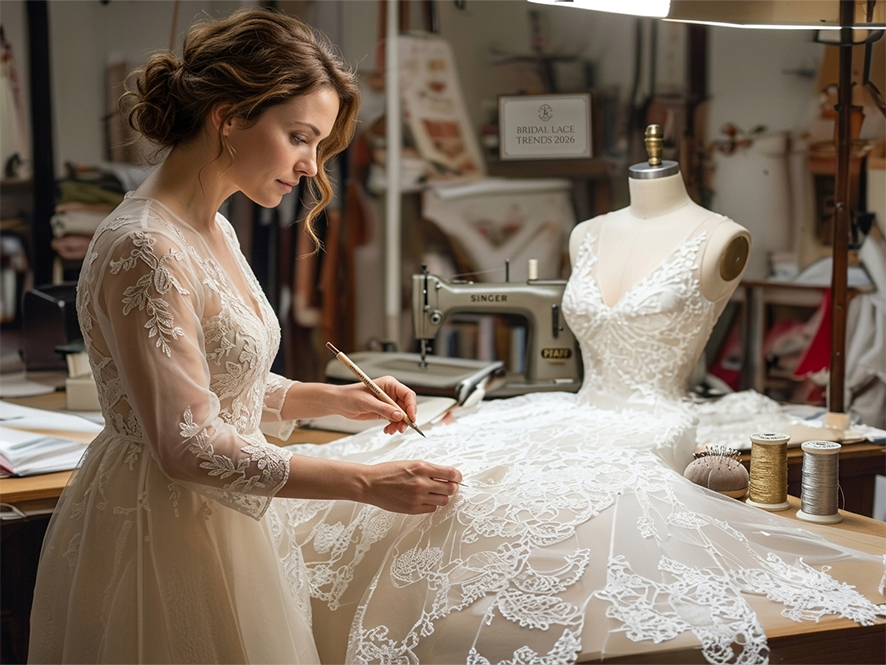
Classic Reimagined: Chantilly Revival in Sleeves, Veils & Detail Work
Chantilly lace, once the hallmark of traditional bridal gowns, is making a sophisticated return—now stripped of its excess filigree and re‑engineered for contemporary silhouettes. Designers are pairing the soft, lacy texture with crisp, minimalistic cuts: quasi‑sheer sleeves, paper‑thin veils, and subtle appliques that echo the lace’s historic delicacy without overwhelming the garment.
Fabric Specs & Costing
Base weight & composition: 250–320 gsm satin‑knit or lightweight polyester‑cotton blend (70 % polyester / 30 % cotton) to keep the fabric airy yet drapeable. When integrated with the Chantilly “fifth” pattern—an ultra‑fine needle lace on a translucent background—the weight drops to 180–230 gsm, ideal for sheer overlays.
Glazing & finish: Soft handwashable glaze (0.8–1.2 mm) gives a subtle sheen. For the contemporary look, a matte glaze is preferred, avoiding the traditional mirror finish. Finish cost averages $12–$18 per square meter, depending on the lace density (120–150 mm² per 100 cm²). The higher density runs—150 mm²—translate to a 6–8 % premium but offer a denser “cloud” effect suitable for sleeve caps.
Price positioning: Mid‑tier segment. A 1 m² roll of Chantilly‑inspired lace costs $36–$48, positioning it between basic polyester lace ($20–$25 m²) and premium silk‑fiber lace ($65–$80 m²). For buyers targeting the EU luxury market, a 0.5 m² packet is $18–$24, making it competitive for boutique designers.
Market Response & Ordering Tips
- US & EU high‑end boutiques: Favor the 250 gsm satin knit with 140 mm² density for sheer sleeves; 50–70 % of orders include a matching veil in the same weight.
- Middle East collectors: Prefer the 320 gsm blend for its opulence; a 10–12 % higher weight is acceptable for a more traditional feel.
- Fast‑turnover labels: Opt for the 180 gsm lightweight variant—requires only 3–5 days for dye and finish—allowing rapid prototype production.
Ordering Practicalities
- Pattern repeat: Chantilly lace typically repeats every 60 cm. Order at least 1.5–2× the repeat for sleeve and veil sections to avoid mismatched seams.
- Scalloped edges: For a refined finish, use the factory’s scallop kit (0.3 mm depth). This adds roughly $1.20 per 2 m² strip and eliminates the need for additional trimming by the buyer.
- Dye lot consistency: Request a single dye lot per order. The dyeing process—Cyan 2.0 % + Pigment 0.5 % in a pH 7.0 bath—ensures neutral ivory versus champagne hues. For ivory/cream shades, a 4‑day dye cycle is standard; for deeper champagne, extend to 5 days to reach 70 % saturation.
- Sample verification: Before committing to bulk runs, procure a 30 cm² sample. Check for uniformity in lattice spacing, glaze depth, and edge scalloping. Verify the exact shade on a white background using a spectrophotometer (D50 reference).
By blending the classic Chantilly motif with modern proportions and contemporary finishing, buyers can offer clients the nostalgia of tradition with the edge of current design trends—making every sleeve, veil, and detail a statement of understated elegance.
Beyond White: Dye‑to‑Match Ivory, Champagne & Blush Palettes for Bespoke Finishing
Modern brides are moving beyond the classic pure‑white silhouette to embrace subtle, warm hues that echo the tone of their wedding rings, seasonal palette, or cultural symbolism. For buyers, the key is sourcing lace that delivers a seamless transition from the base fabric to the finished piece. The following practical guidelines focus on dye‑to‑match techniques for ivory, champagne and blush tones, ensuring consistency across runs and markets.
1. Base Fabric Specifications
- Fabric weight: 120–140 gsm (2–2.3 oz) for delicate chiffon or organza blends; 160–180 gsm (3–3.4 oz) for sturdier satin or silk‑cotton mixes.
- Thread count: 200–240 for fine lace, 240–280 for structured guipure.
- Pre‑dye finish: 1–2 % pre‑bleach for ivory, 3–4 % for champagne to reduce final color variance.
2. Dyeing Process & Timing
- Batch size: 500 m² per dye lot for small‑batch designers; 1 000 m² for high‑volume houses.
- Drying time: 36–48 hours at 60 °C before post‑wash.
- Post‑wash shrinkage: < 0.5 % to maintain pattern repeat integrity.
- Lead time: 10–12 days from receipt of sample to final dyed product.
3. Color Match & Quality Controls
- Color fastness: 8/10 on the standard ISO 105-X12 scale.
- Hue consistency: ± 1 ΔE across the batch.
- Shade calibration: Use a Pantone reference panel (e.g., PANTONE 13‑1525 “Champagne Rose”, PANTONE 12‑6306 “Blush”).
- Sample approval: Clients can request a 30 cm² swatch per dye lot; approval window: 3 business days.
4. Market Preferences
- United States: 70 % of bridal buyers prefer ivory for classic elegance; 20 % opt for champagne in fall weddings.
- European Union: 60 % of designers use blush for spring and summer lines; 25 % integrate champagne in formal evening gowns.
- Middle East: 80 % favor ivory as a neutral base, with 15 % blending in muted blush for luxury veils.
5. Ordering Tips for Dye‑to‑Match Lace
- Pattern repeat: Order lace with a minimum repeat of 15 cm to allow for seamless tailoring and avoid visible stitching.
- Scalloped edges: Request scalloped or rolled edges to conceal raw cut lines; standard width 4 mm for chiffon, 6 mm for satin.
- Dye lot consistency: Verify that all pieces within a single order come from the same dye lot; label with lot number and date.
- Pricing: Expect a premium of $0.75–$1.20 per square meter for custom dye runs compared to standard white lace.
By integrating precise dyeing protocols, matching repeat patterns, and clear quality controls, buyers can confidently offer brides a range of warm, bespoke lace hues that elevate the wedding experience while maintaining production efficiency and consistency across markets.
Order Smart: Matching Repeat, Scalloped Edges & Dye Lot Consistency for Buyers
When you’re sourcing lace for a new line, the devil is in the details. A well‑planned order can save you time, cut waste and ensure your gowns feel cohesive. Below are the key touchpoints designers and buyers should audit before signing the purchase order.
1. Pattern Repeat Alignment
- Measure the repeat length: A typical guipure or Chantilly lace has a repeat of 45–60 cm. Order cuts in multiples of this repeat to avoid excess or shortage when constructing the bodice.
- Check for overlap: 3‑D floral lace often has a 30 cm repeat but the “pop” petals may extend an extra 5 cm on each side. Ask for a visual diagram of how the repeat aligns across the piece.
- Use a sampling panel: Request a 10 × 10 cm test panel. Spin this panel onto a 1 m² swatch to verify that the pattern lines up when scaled.
2. Scalloped Edge Uniformity
- Edge width: Most bridal lace calls for a scalloped edge 1.5–2 cm wide. Verify the edge width in the technical package and confirm that the scallop depth is consistent across the lot.
- Edge material: If the lace is over‑printed or embroidered, ensure the edge is made of the same yarn as the body (e.g. 100 % nylon for a vegan option) to prevent snagging.
- Edge treatment: For a polished finish, request a mild “edge burnish” or “soft edge” finish that reduces fraying without compromising the scallop’s visual appeal.
3. Dye Lot Consistency for Color‑Critical Orders
Blush, champagne and ivory are trending beyond pure white. Even small variations can shift a brand’s aesthetic. Follow these guidelines to lock in color accuracy.
- Dye lot size: Aim for a minimum of 10 kg per color to maintain batch uniformity. A smaller lot (5 kg) often leads to higher intra‑lot variance.
- Color data: Request Lab values (CIE L*a*b*) for each dye lot and a tolerance range (±2 units on the L* axis is acceptable for bridal fabrics).
- Pre‑order sample: Order a 2 m² swatch of the final color before committing to the full run. Measure the L*, a*, b* values in your own lab or a third‑party testing facility.
- Storage conditions: Store dyed lace in a cool, dry environment (≤22 °C, <60 % RH). Light exposure should be limited to <500 lux to prevent bleaching.
- Delivery schedule: Lock in a lead time of 35–45 days from order confirmation to first shipment. Buffer 5 days for potential dye‑ing adjustments.
4. Gross Weight & Handling
Bridal lace ranges from 30–70 gsm (3.5–8.2 oz/m²). The weight affects drape, cutting and packaging:
- Lightweight lace (30–45 gsm): Ideal for sheer overlays; pack in 1 m² rolls to avoid creasing.
- Mid‑weight lace (45–60 gsm): Common for veils and sleeves; use 3 × 3 m panels to reduce cutting waste.
- Heavy lace (60–70 gsm): Best for structured skirts or full bodices; spool in 5 × 5 m sections.
Weigh each roll in your warehouse and compare with the supplier’s specification sheet. If the variance exceeds ±5 % of the target gsm, request a new batch.
5. Quality Checks Before Shipping
- Visual inspection: Verify that the pattern repeat, scalloped edge, and color match the technical drawings. Look for any missing or over‑printed areas.
- Dimensional accuracy: Measure the panel thickness with a micrometer; should be within ±0.5 mm of the spec.
- Functional test: Fasten a sample piece to a mannequin to test drape and seam strength. A good lace should hold a seam without puckering.
- Documentation: Ensure each shipment comes with a certificate of compliance, dye lot details, and any relevant sustainability credentials (e.g., GRS for recycled fibers).
Conclusion: Turning Lace Trends into Smart Buying Decisions
In 2026, bridal lace is moving from the runway to the production floor with a clear focus on texture, sustainability and subtle sparkle. Designers are gravitating toward 3D floral petals that add depth without bulk, geometric guipure that lends clean lines to contemporary silhouettes, and recycled cotton blends that meet eco‑credentials. A gentle shimmer and discreet sequin accents keep the look glamorous yet understated, while a revived Chantilly style offers romantic detail for sleeves and veils. Finally, jewel‑tone palettes—ivory, champagne and blush—are replacing the traditional all‑white, giving brides a fresh, personalized aesthetic. These directions translate into specific buying cues: choose high‑density lace bases for 3D motifs, mid‑weight polyester for geometric cuts, and blended cotton‑polyester for sustainable lines; target the US and EU for modern minimalist styles, the Middle East for luxurious shimmer, and emerging markets for Chantilly revival. When ordering, pay close attention to pattern repeat alignment and scalloped edge integrity, and confirm dye lot consistency across orders.
For buyers looking to stay ahead, the rule of thumb is to sample the texture and color match before committing to bulk runs, and to maintain open communication with suppliers for rapid turnaround. Yituo Fabric, with over two decades of experience and a 20,000 m² facility, offers precisely the quality and variety needed to bring these trends to life. Contact us today to receive free A4 fabric swatches—our 24‑hour reply promise ensures you can make informed, confident decisions in real time.