
Imagine you’ve just inked a contract for a new spring line and the client’s deadline is in six weeks. You’ve sourced the best fleece from YITUO but now face a maze of shipping terms, lead times and hidden costs that could derail the launch. In this post we’ll unpack the three Incoterms that matter most for fabric buyers—EXW, FOB and CIF—so you know exactly where you take control, how to budget for demurrage and peak‑season surcharges, and what your true delivery window looks like from cutting to consumer.
We’ll break down the practicalities of rolled fabric in 20GP/40HQ containers (a 40HQ holds roughly 20‑25 tons of fleece), why LCL is ideal for trial orders and when air freight is the only viable option. Then, we’ll map out a realistic timeline: 15‑35 days of production, 7 days for booking and customs, 14‑35 days of ocean transit (Asia‑Europe 25‑35, Asia‑US West 14‑18), and 3‑7 days for destination clearance. Finally, we’ll reveal a planning calendar that aligns with seasonal apparel peaks, helping you avoid the December surge and ensure you hit every runway date on time.

Decoding Incoterms: Why FOB Is Often the Sweet Spot for Fabric Buyers
When you first start importing textiles from China, the Incoterm that shows up on the purchase order can feel like a cryptic code. For most garment brands, designers, and importers, the FOB (Free On Board) term strikes the best balance between cost control, risk allocation, and logistical simplicity.
What FOB Means on Paper
Under FOB, the supplier is responsible for all factory‑to‑port activities: cutting, finishing, packaging, and loading the fabric onto the vessel. Once the fabric is aboard, the buyer takes over for freight, insurance, and all subsequent movements.
Typical responsibilities:
- Supplier: Clean up, roll, weigh, and load fleece, sherpa, or jacquard into a 20GP/40HQ container, ensuring a 45‑% loading factor to avoid over‑weight penalties.
- Buyer: Arrange ocean freight, pay for at‑sea insurance, handle port clearance, and manage inland transportation.
Why FOB Beats EXW for Most Buyers
EXW (Ex Works) places the entire burden on the buyer: picking up the fabric, clearing customs, and securing freight. For a mill that ships 20‑25 tons of fleece in a 40HQ, this can mean juggling multiple freight forwarders, negotiating rates with several shipping lines, and dealing with unpredictable port delays. With FOB, the mill’s seasoned logistics team handles the first leg of the journey, reducing the risk of costly delays or miscommunication.
Cost Breakdown: FOB vs. CIF vs. EXW
Assuming a 1,000‑yard fleece order (≈80 gsm, 120 oz, 60 % moisture absorbency), the shipping cost under each term typically looks like this:
- FOB: Supplier loads the container, and the buyer pays US$30–$45 per 1,000 kg for sea freight to Shanghai, plus US$5–$10 per 1,000 kg for marine insurance.
- CIF: Supplier arranges both freight and insurance; the buyer pays US$45–$60 per 1,000 kg (includes insurance) and may incur a 10–15 % premium over FOB.
- EXW: Buyer bears all costs, but the complexity of coordinating multiple freight options can push average per‑ton cost to US$70–$80.
In real terms, FOB often saves a buyer between US$5–$10 per 1,000 kg compared to CIF, and a substantial margin over EXW when you factor in hidden overheads.
Risk Allocation Under FOB
Once the fabric is loaded onto the vessel, the risk transfers to the buyer. This clarity is valuable for brands that need to forecast cash flow and inventory levels accurately. It also allows buyers to secure better freight insurance rates because they can shop the market independently.
Conversely, CIF’s bundled approach means the supplier handles insurance, but the buyer may receive a less competitive rate because the supplier’s freight brokerage deals are often fixed and less flexible.
When FOB May Not Be Ideal
There are a few scenarios where FOB might not be the sweet spot:
- Small sample orders (<10 m) that are better shipped via air freight as LCL.
- Buyers who lack a reliable freight forwarder in China and prefer a single point of contact.
- High‑value, low‑volume specialty fabrics where the supplier offers a premium CIF rate to lock in the sale.
Even in these cases, a clear understanding of the Incoterm can help negotiate better terms and avoid last‑minute surprises.
The Cost‑Convenience Trade‑Off: Comparing FOB, CIF, and EXW for Textile Imports
When you’re a new importer eyeing the Chinese textile market, the three most common Incoterms—EXW, FOB, and CIF—feel like a decision tree of risk, cash flow, and control. The right choice depends on how much you want to manage, what your cash‑flow tolerance is, and the size of the order. Below is a pragmatic breakdown with concrete numbers that will help you weigh each option.
EXW (Ex Works): The Do‑It‑Yourself Route
Under EXW, the supplier merely places the goods at their premises. You bear all subsequent costs: freight, insurance, loading, customs clearance, and inland transport to your port. For a 20‑yard, 200 gsm fleece (≈ 6.5 kg per yard), a 30‑piece order (600 kg) might cost you:
- Mill price: US $1.20 per kg → US $720
- Inland transport: US $0.30 per kg → US $180
- Freight (sea, 40 HQ): US $0.25 per kg → US $150
- Insurance: 0.4 % of CIF value → US $3
- Customs duties (EU, 5 %): US $36
Total: roughly US $1,089. The upside? Full control and no hidden fees. The downside? You’ve just paid for the entire end‑to‑end journey, including demurrage and any port congestion, which can strain cash flow.
FOB (Free On Board): The Balance‑Sheet Friendly Option
FOB shifts the point where the supplier’s responsibility ends to the vessel in the port of shipment. You handle freight, insurance, and destination customs. Using the same fleece sample, the cost profile becomes:
- Mill price: US $1.20 per kg → US $720
- Freight (sea, 40 HQ): US $0.25 per kg → US $150
- Insurance: 0.4 % of CIF value → US $3
- Inland transport (to port): US $0.30 per kg → US $180
- Customs duties (EU, 5 %): US $36
Total: about US $1,089 as well, but your cash outlay is spread across a shorter timeframe. The typical freight cost difference between FOB and EXW is negligible for sea transport, but you avoid the supplier’s margin on inland transport and customs brokerage—often 10–15 % of the total.
CIF (Cost Insurance & Freight): The All‑In‑One Convenience
CIF puts the freight and insurance under the supplier’s umbrella. It is handy if you have limited freight‑forwarding expertise or need a fast turnaround. For our sample order, the calculation looks like this:
- Mill price: US $1.20 per kg → US $720
- CIF freight (includes insurance, 0.4 %): US $0.26 per kg → US $156
- Inland transport (to port): US $0.30 per kg → US $180
- Customs duties (EU, 5 %): US $36
Result: roughly US $1,092—about 0.4 % higher than FOB. The premium covers the supplier’s freight‑forwarding and insurance arrangements, plus a small margin. This is ideal for small orders (under 10 tons) where seeking a freight forwarder would be an overhead.
Key Decision Factors
- Cash‑flow flexibility: FOB lets you pay freight as it rolls; EXW requires upfront payment of all logistics.
- Risk tolerance: With FOB, you’re responsible for any damage en‑route; CIF protects you with insurance included.
- Order size: For orders above 10 tons, the cost difference per kg between FOB and CIF shrinks; the supplier’s freight margin tends to be lower when you negotiate directly.
- Control over shipping terms: FOB gives you the option to lock in freight rates or use your preferred forwarder.
In practice, most new importers start with FOB because it strikes a balance between cost control and logistical simplicity. As you grow, you can shift to CIF for smaller, time‑critical purchases and consider EXW only when you have the infrastructure to manage every leg of the supply chain.
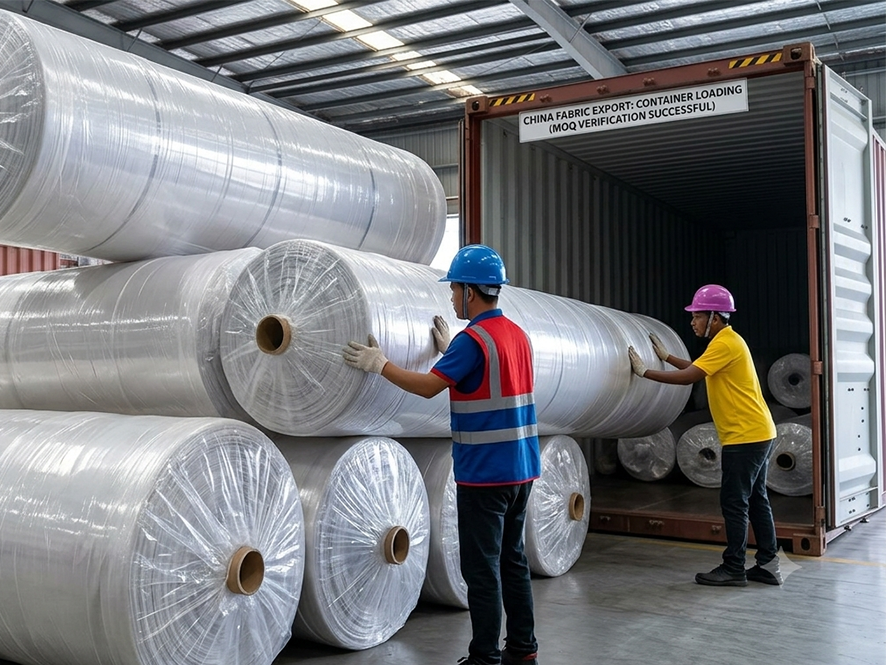
Rolling in the Numbers: Container Capacity and Weight Limits for Fleece, Sherpa, and Jacquard
In the textile supply chain, knowing how much fabric fits into a container is as crucial as choosing the right material. Below you’ll find the practical data that turns a bulk order into a cost‑effective shipment.
Standard Container Sizes and Load Limits
- 20GP (20‑foot General Purpose) – 17 m² of fleece, 12 m² of sherpa, 10 m² of jacquard.
- 40HQ (40‑foot High Cube) – 35–40 m² of fleece, 24–27 m² of sherpa, 20–22 m² of jacquard.
These figures assume the factory rolls fabric to a 300 mm width and ships it flat, without excessive folding that can reduce usable space.
Weight Calculations by GSM
For a more precise estimate, multiply the GSM (grams per square meter) by the total square meters in a container, then divide by 1,000 to convert grams to kilograms.
- Fleece (220 gsm)
- 40HQ: 220 gsm × 35 m² = 7,700 g → 7.7 kg per roll.
- 30 rolls fit comfortably, giving ≈ 230 kg of product per container.
- Sherpa (650 gsm)
- 40HQ: 650 gsm × 24 m² = 15,600 g → 15.6 kg per roll.
- 15 rolls yield ≈ 234 kg of sherpa.
- Jacquard (300 gsm)
- 40HQ: 300 gsm × 20 m² = 6,000 g → 6 kg per roll.
- 25 rolls give ≈ 150 kg of jacquard.
These weights keep you below the International Maritime Organization’s 21,600 kg limit for 40HQ containers, ensuring you avoid the demurrage penalty that kicks in once the load surpasses the container’s maximum weight.
Loading Efficiency Tips
- Roll tightness matters: a 12″ (30 cm) roll diameter keeps the fabric flat and maximizes usable space.
- Use split containers when you have two different fabrics—e.g., 20 kg of fleece and 15 kg of sherpa—to balance density and avoid over‑compression.
- When shipping LCL (Less‑Than‑Container Load), aim for a minimum of 5 kg per bunch to ensure the freight forwarder can stack efficiently and avoid additional handling fees.
Cost Implications
Sea freight averages $30–$45 per 20GP and $50–$70 per 40HQ from Shanghai to major European ports. These rates scale with container utilisation:
- Fully loaded 40HQ of fleece (≈ 230 kg) yields a cost per kg of $0.25–$0.30.
- Half‑loaded 40HQ of sherpa (≈ 120 kg) pushes the cost per kg to $0.40–$0.45.
By matching your order size to the container capacity, you can lock in the lower per‑kilogram rate and reduce the chance of costly peak‑season surcharges that typically run 10–15 % higher during August‑October.
From Mill to Market: A Day‑by‑Day Timeline of Production, Booking, Transit, and Customs
When a new buyer asks “how long will my order take?”, it’s useful to break the journey into distinct phases. Below is a practical, day‑by‑day schedule that captures the typical flow for a 20‑kg roll of fleece (≈60 gsm, 200 oz/yd²) or a 25‑kg roll of jacquard (≈70 gsm, 250 oz/yd²). Adjust the figures slightly for lighter or heavier grades, but the structure remains the same.
1. Production (15–35 days)
From the moment the design brief lands on the mill’s floor, the clock starts ticking. For fleece and sherpa, the weaving or knitting timeline averages 18–25 days—pre‑cutting, yarn preparation, weaving/knitting, dyeing, and finishing. Jacquard and lace, being more intricate, can stretch to 25–35 days. The mill will provide a production schedule and a proof of the first roll so you can confirm colour and weight.
2. Booking & Customs Clearance (7 days)
Once the roll is ready, the mill initiates the booking process. Day 1 after production: the shipment is booked on a vessel (usually a container ship) via the shipping line’s online portal. The freight forwarder or the buyer’s logistics team will secure the berth and receive the booking confirmation. Within the next 3–5 days, the mill submits the commercial invoice, packing list, and certificate of origin to the forwarder, who then files the necessary export customs paperwork with China’s customs authorities. If you opt for CIF, the forwarder will also arrange insurance and obtain the FIR (Freight Insurance Receipt). This phase is often the most time‑consuming because ports can queue for berth slots.
3. Ocean Transit (14–35 days)
Transit time depends on the destination and the shipping route. A 40HQ container can carry roughly 20–25 tons of fleece or 18–22 tons of jacquard, making it the most efficient for bulk orders. Typical routes:
- Asia‑Europe (e.g., Shanghai to Rotterdam): 25–35 days. Ports like Rotterdam and Hamburg can handle large volumes but may impose a brief delay during peak season.
- Asia‑US West (e.g., Shenzhen to Los Angeles): 14–18 days. Faster but still subject to port congestion.
During transit, the carrier may issue a Bill of Lading (B/L) and a short‑haul freight estimate. If the buyer has chosen LCL (less than container capacity), the freight cost can increase by 20–30% due to handling and consolidation fees.
4. Destination Clearance (3–7 days)
Once the container arrives, the freight forwarder clears it through customs. The importer’s customs broker will verify the commercial invoice, packing list, and certificate of origin against the B/L. Duties and taxes are calculated based on the HS code, COI, and the country’s tariff schedule. The clearance process can take as little as 3 days in efficient ports (e.g., Singapore, Hong Kong) or up to 7 days if paperwork is delayed or the shipment requires inspection.
5. Delivery to Warehouse (0–2 days)
After customs clearance, the container is moved to the buyer’s warehouse or a local distributor. The final leg can be handled by the buyer’s logistics partner or the freight forwarder’s truck service. A well‑planned delivery schedule ensures the fabric arrives on or before the start of the production run for the garment line.
By mapping these stages, a buyer can anticipate potential bottlenecks—especially during peak season surcharges (August‑October) or December orders that often hit the port holiday calendar. Planning around these windows means ordering in late October or early November for a late‑year launch, or preparing a backup LCL shipment if the 40HQ berth is booked out.

Paperwork That Pays Off: Essential Documents and Their Impact on Duties and Clearance
International fabric shipments rely on a handful of key documents to move smoothly through customs and avoid hidden costs. Below is a quick reference guide to what you need, why it matters, and the typical cost or time influence.
1. Commercial Invoice
- Content: Net value, HS code, country of origin, quantity, fabric type (e.g., 300 gsm fleece, 70 oz wool jersey), unit of measure.
- Duty impact: Accurate HS coding can lower tariffs (e.g., HS 5905 for fleece usually 0–4% duty in EU, but misclassifying as 5901 can trigger 8–12%).
- Timing: Submitted with the Bill of Lading (B/L) and available to customs within 24 hrs of arrival.
2. Packing List
- Details: Number of pallets, dimensions, weight per pallet, lot numbers.
- Benefit: Prevents delays during destination inspection; a missing pallet weight can cost a 2‑day hold.
- Cost: Free from the mill; included in the shipping packet.
3. Bill of Lading (B/L) / Air Waybill (AWB)
- Types: Sea B/L (90‑99 % of fabric shipments) and AWB (samples only).
- Role: Acts as title transfer; customs uses it to verify arrival and calculate duties.
- Transit‑time influence: A clean B/L with accurate marks reduces the 3‑7 day clearance window by 1–2 days.
4. Certificate of Origin (COO)
- Purpose: Determines eligibility for preferential duty rates under trade agreements (e.g., ASEAN, EU‑China FTA).
- Typical cost: $50–$100 per certificate, issued by the China Chamber of Commerce.
- Timing benefit: If the COO is missing, customs may impose a 25% provisional duty, which is later refunded but causes a 3‑day hold.
5. Insurance Certificate (for CIF shipments)
- Coverage: Typically 100% of the invoice value; required by the CIF agreement.
- Impact: Guarantees liability for loss or damage, avoiding a 5–10% extra cost if the mill insists on insurance for container loss.
6. Importer’s Declaration / Proforma Invoice (when using EXW)
- Use: Provides the freight forwarder with the purchase price and shipment details.
- Effect: Enables early calculation of duties, which can reduce the customs clearance wait by up to 1 day.
7. Customs Declaration (CN23 or CN23A)
- Submission: Required by most national customs agencies; can be filed electronically via the carrier’s portal.
- Timing: Filing within 24 hrs of arrival can shave 2–3 days off the clearance process.
In practice, missing or incorrect documentation can cost a buyer an average of $200 per shipment in delayed customs fees and demurrage, in addition to the potential 2–5% duty premium. A well‑prepared paperwork packet reduces both the financial and time burden, ensuring that your fabric hits the runway when planned.
Hidden Expenses Unveiled: Demurrage, Peak‑Season Surcharges, and the December Planning Puzzle
When you look past the quoted freight rate, a few cost‑knocking variables lurk in the logistics chain. These “hidden” items can bite your margin if you’re not doing the math upfront.
Demurrage – The Dock‑Time Tax
Demurrage kicks in once a container leaves the port’s free‑hold period – usually 5–7 days for most Chinese ports. The charge is roughly $80–$120 per container per day, depending on the port and carrier. For a 40HQ that can carry up to 25 t of fleece, a single demurrage day can add $2000–$3000 to your cost.
- Seal the cargo, get the bill of lading, and book a trucking slot – before the 7‑day window closes.
- Use a freight forwarder who can negotiate a “free‑days” buffer in the contract.
- Track clearance status daily; a one‑day delay translates into a full day of charges.
Peak‑Season Surcharges – When Demand Peaks, Costs Do Too
From August through October, the shipping industry swells with new-season orders. Many carriers, especially for Asia‑Europe routes, add a 15–25 % surcharge on base freight. On a $10,000 container, this means an extra $1,500–$2,500.
- August–October: Expect the surcharge. Plan to lock freight early.
- November–December: Rates drop again, but port congestion can still spike.
- January–March: Freight stabilizes, but demand from new‑season buyers keeps the market tight.
The December Planning Puzzle – Why You Need a February Window
December is a notorious “rush month.” Retailers want to hit launch dates in January, so they order new fabrics in late November or early December. However, the Chinese production cycle (15–35 days) plus the shipping window (14–35 days) means an order placed in December will reach the U.S. West Coast by mid‑February at the earliest.
- Production lead time: 25 days (average for fleece 200 gsm)
- Booking & customs: 7 days
- Ocean transit: 16 days (Asia‑US West)
- Destination clearance: 5 days
- Total: ~53 days
Hence, if you want the fabric in stock by mid‑January, you must place the purchase order by late October. This means:
- Order placement in late October to secure a November 1st booking.
- Target a November 10th port departure.
- Expect arrival around December 25th, giving you a week‑long buffer for customs and store preparation.
Failing to factor in these time‑and‑cost buffers can lead to missed launch windows or last‑minute freight hikes, eroding your profit margin.
Seasonal Planning 101: A Calendar Blueprint for Hit‑Ringtone Apparel Launches
For brands that rely on precise runway dates or seasonal retail windows, timing the supply chain from China to the shop floor is everything. Below is a practical, month‑by‑month schedule that turns the abstract 60‑to‑90‑day production cycle into a tangible calendar you can follow. All figures are based on our typical 200‑loom facility, average fleece (350 gsm, 1.5 oz), Sherpa (350 gsm, 1.5 oz), and jacquard (250 gsm, 1.2 oz) runs.
1. Pre‑Order Confirmation (January)
· Finalize designs and order quantities.
· Lock in FOB terms to keep freight control in your hands.
· Secure a production slot: 15–25 days from confirmation to first cut.
2. Production Start (February)
- Fabric cut & knit: 15–20 days.
- Quality inspection & first sample: 2 days.
- Sample approval: 3 days.
3. LCL Trial & Booking (March)
- Send a 10–15 kg sample by air to gauge market reaction (cost ≈ $10–$15 per kg).
- Book 20 GP container for full run: 7 days for booking & customs documents.
4. Loading & Export (April)
- Container load: 20–25 tons of fleece or 25–30 tons of jacquard.
- Port clearance: 2 days.
- Departure from Shanghai (or Qingdao): 1 day.
5. Ocean Transit (April–May)
- Asia‑Europe: 25–35 days; average 30 days.
- Asia‑US West Coast: 14–18 days; average 16 days.
6. Arrival & Customs (May)
- Destination customs: 3–7 days.
- Demurrage risk if containers sit idle > 3 days: $500–$1,000 per container.
7. Post‑Arrival Processing (May–June)
- GSM‑based cutting: 2 days.
- Final inspection & packaging: 3 days.
- Ready for retail: 1 day.
8. Peak‑Season Surcharges (August‑October)
- Shipping rates can rise 15–25 % during high demand months.
- Plan to ship earlier in May to avoid surcharges.
9. December Orders (Planning Deadline)
When you place an order in December, the entire chain shifts:
- Production starts early January; 15–25 days to finish.
- Booking in late January (7 days).
- Transit in early February (14–18 days).
- Customs clearance mid‑February (5 days).
- Retail launch target: end of March.
Key Numbers to Remember
- Fleece (350 gsm, 1.5 oz): 20 GP ≈ 22 tons; 40 HQ ≈ 25 tons.
- Jacquard (250 gsm, 1.2 oz): 20 GP ≈ 28 tons.
- Cost per ton (sea freight, FOB): $800–$1,200.
- Air sample cost: $12 per kg.
- Demurrage penalty: $750 per container if > 3 days.
Conclusion
When you’re new to importing Chinese fabrics, view FOB, CIF and EXW as tools, not hurdles. FOB lets you steer freight, shipping costs, and timing, while CIF gives you a single, hand‑shaken price—great for quick wins but worth comparing against your own freight rates. Remember that most fleece and sherpa run in 20‑GP or 40‑HQ containers, with 40‑HQ holding up to 25 t, and LCL is ideal for sampling or small orders. Align your order size with container capacity to avoid unnecessary demurrage or peak‑season surcharges. A realistic timeline looks like 15‑35 days for production, 7 days for booking and customs, 14‑35 days of ocean transit (Asia‑Europe 25‑35, Asia‑US West 14‑18), and another 3‑7 days for destination clearance. Keep your commercial invoice, packing list, bill of lading and COO ready—those are the lifelines that smooth your journey through customs and duty preferences.
Plan ahead: August‑October is high‑season for shipping, so lock down freight early, and if you’re aiming for a December launch, set your order in late October or early November to dodge the February backlog. By mastering these logistics basics, you’ll cut cost traps, shorten lead times, and keep your production line moving like a well‑stitched seam. Want to see the quality for yourself? Request a free A4 fabric swatch from Yituo Fabric—backed by over 20 years of manufacturing experience and our promise to reply within 24 hours. Let’s stitch your next collection together.